
Roll & Narrative System – Introduction
This system is a Dungeon Master–guided narrative game where characters interact with the world of Azeroth through roleplay and dice rolls.The Dungeon Master (DM) describes the environment, situations, and unfolding events. Players then declare what their characters attempt to do. When the outcome of an action is uncertain, the DM may call for a dice roll to determine success or failure.A character’s skills, attributes, and proficiencies can modify these rolls, representing what that character is naturally better—or worse—at doing.The goal of the system is not simply to win rolls, but to tell a shared story, where character decisions, risks, and actions shape the outcome of events and may influence future adventures.
Dungeon Master (DM) driven events unfold in the world of Azeroth, where sword and sorcery are daily bread for our characters.
Much like the games we played when we were younger, these events are fuelled by imagination. We picture the ruins of a forgotten keep in a dark forest. We imagine the wind across a broken battlement. We ask ourselves: How would my character react in this moment?
In this magical world, the possibilities are vast.
The DM system provides structure to these stories. It exists to determine the consequences of your character’s actions. When uncertainty arises—whether a blade strikes true, whether a cliff is climbed, whether a spell is resisted—the dice and your character’s statistics determine the outcome.
Your choices matter. Your skills matter. The roll simply resolves probability.
1) The Description
The DM describes the environment and ambience.
You are told where you are, what is visible at first glance, and what is immediately apparent.
How many doors are in the chamber?
Who are the patrons in the tavern?
What lies on the table?
This is the starting frame.
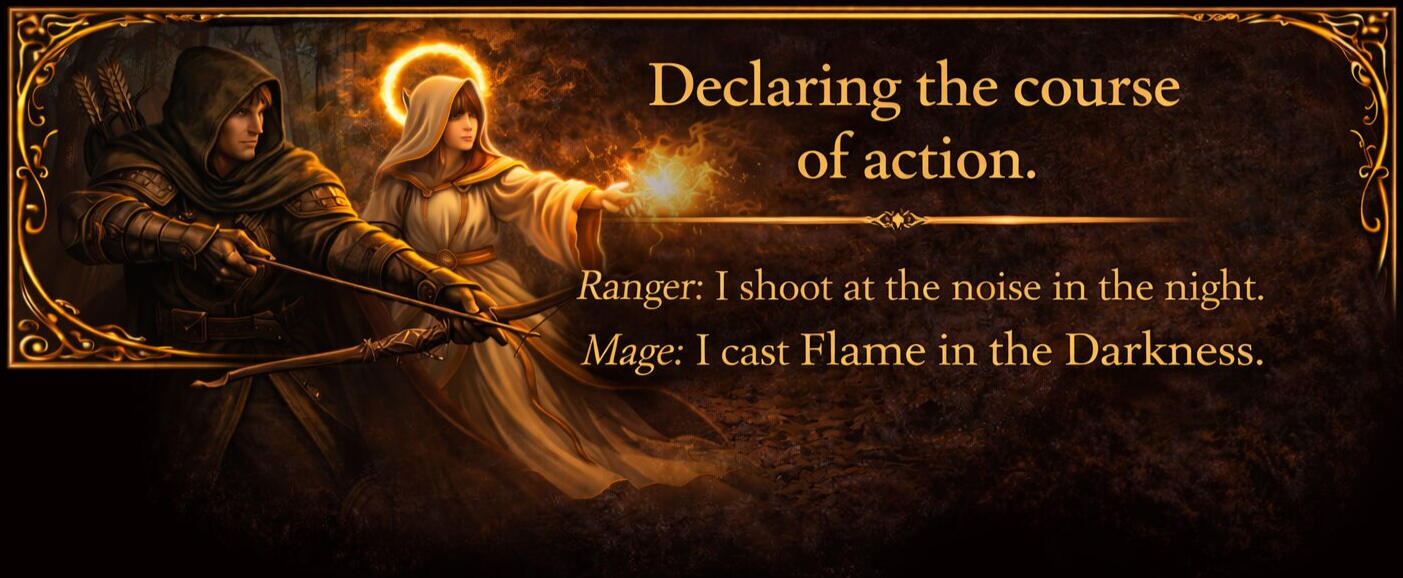
2) The Declaration
Players decide what their characters do.
Sometimes one player speaks on behalf of the group.
Sometimes each character acts independently—one searches a chest, another studies a symbol, a third stands watch.Important Rule — Keep It Short in Raid / Party Chat
When declaring an action, write a short and clear description in Raid or Party chat.
This allows the DM to immediately understand:
What your character is attempting.
What skill or Domain may apply.
Whether a roll is required.Longer emotes, speeches, internal thoughts and atmospheric writing are welcome in:
/e (emote)
/s (say)
But the essential action must be clearly stated in Raid / Party.
This is not a limitation of roleplay—it is a structural necessity that keeps the event fluid and fair.
Players do not need to wait for strict turns in fluid situations, but courtesy dictates allowing the DM to respond before escalating actions. When combat arises, the DM may instruct to proceed via turns or rounds.
3) The Resolution
The DM evaluates the declared actions and determines outcomes.
Some actions require no roll.
Some actions automatically fail.
Some actions require a roll.
Rolls Are Called — Never Self-InitiatedA player does not roll unless instructed by the DM.
If no roll is requested, none is needed.
When a roll is called:
Default is /roll 100.
Other dice may be requested situationally.
Add relevant modifiers from your Core Domains or Knowledge when applicable.
Write the total result in Raid / Party chat.
For most actions, only one roll is allowed.
If you fail, you fail.
The DM then narrates the consequences.
The scene evolves.
The cycle begins again.
Players are not passive observers.
You are not following a script. You are participants in an unfolding mission or campaign.You may (IC):
Propose plans.
Take tactical initiative.
Influence decisions.
Argue courses of action.
Shape how the group approaches a situation.Your character’s actions can:
Change the outcome of the current event.
Alter the direction of future missions.
Create political consequences.
Generate new storylines.
Strengthen or fracture internal dynamics.Actions carry weight.
Mercy may return later.
Recklessness may have repercussions.
Failure to act may cost opportunity.However, initiative does not mean fragmentation.
Small tactical actions — such as scouting a short distance ahead — are natural and often expected.
But extensive group splitting (for example, two independent teams operating simultaneously across the event) significantly slows pacing and strains the flow of the narrative.
The DM must balance clarity, time, and fairness for all participants.As such:
Major separations of the party should be rare.
Group cohesion is encouraged.
Decisions are ideally discussed before they are executed.
The system supports initiative.
It also relies on cooperation.
The strength of the event lies in shared momentum.

When an outcome is uncertain, fate rests in the dice.
The standard roll is /roll 100.
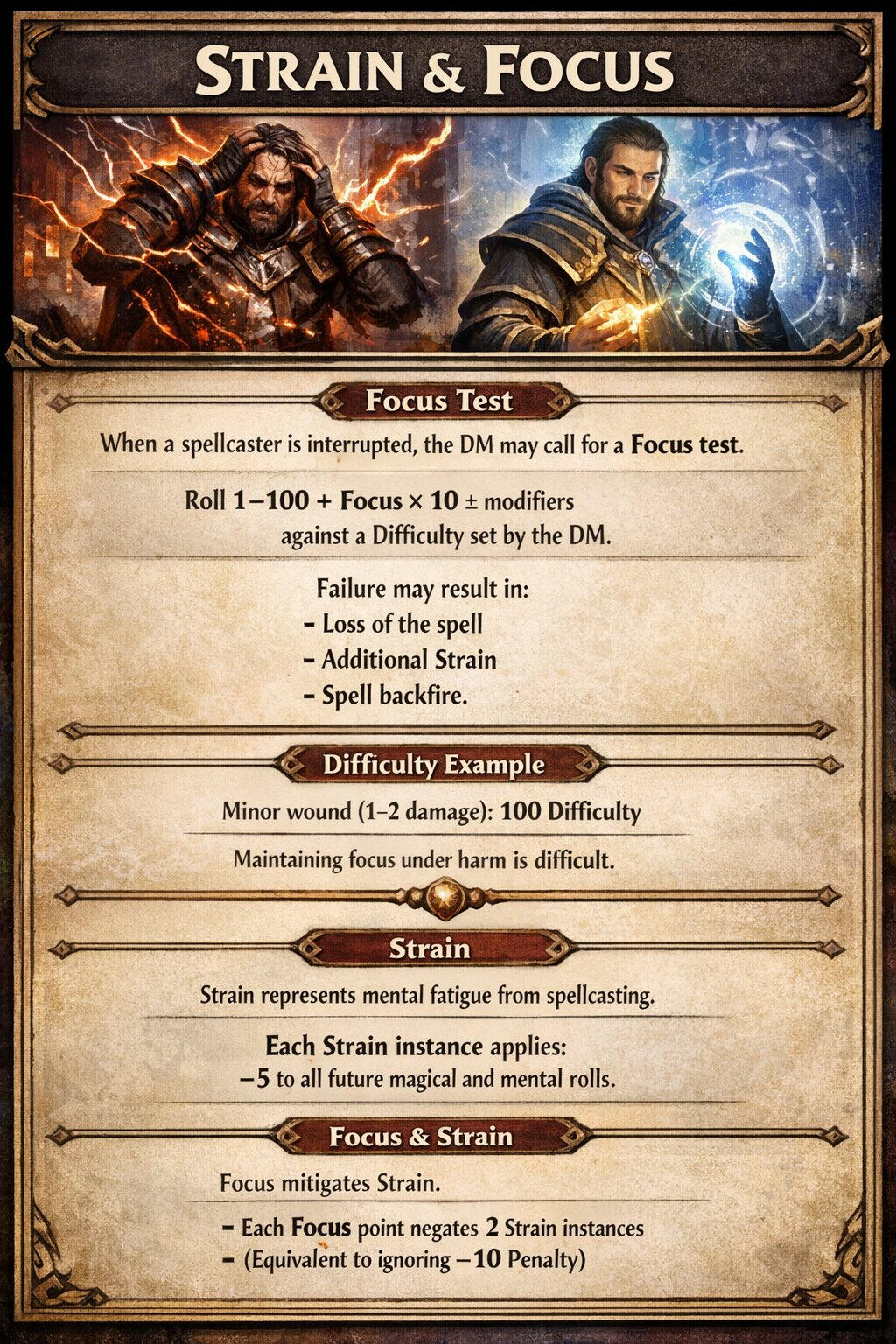
Other dice may be requested (/roll 6, etc.) depending on circumstance.Modifiers may apply due to:
Core Domain ranks (Primary, Secondary, Tertiary)
Knowledge Proficiencies
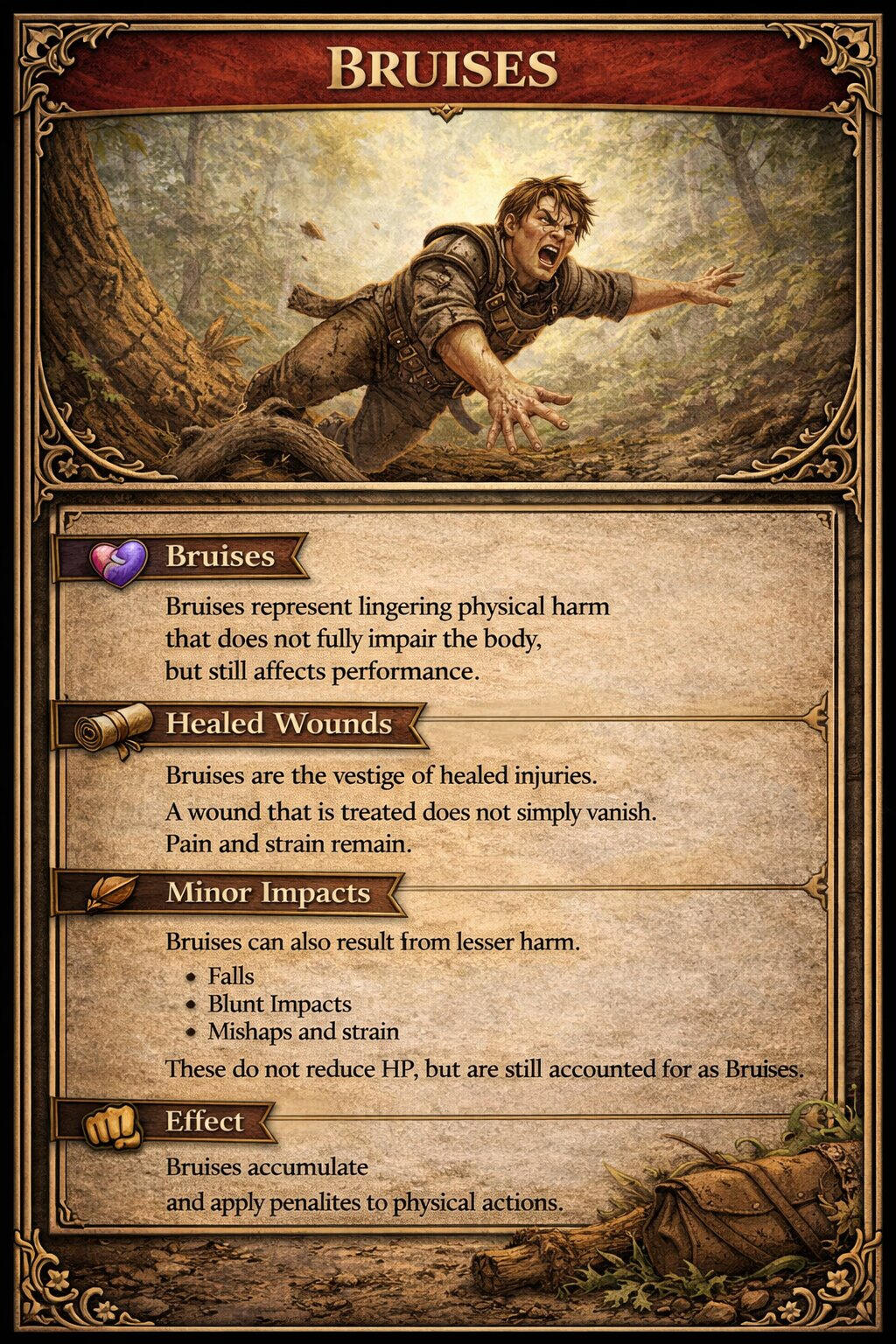
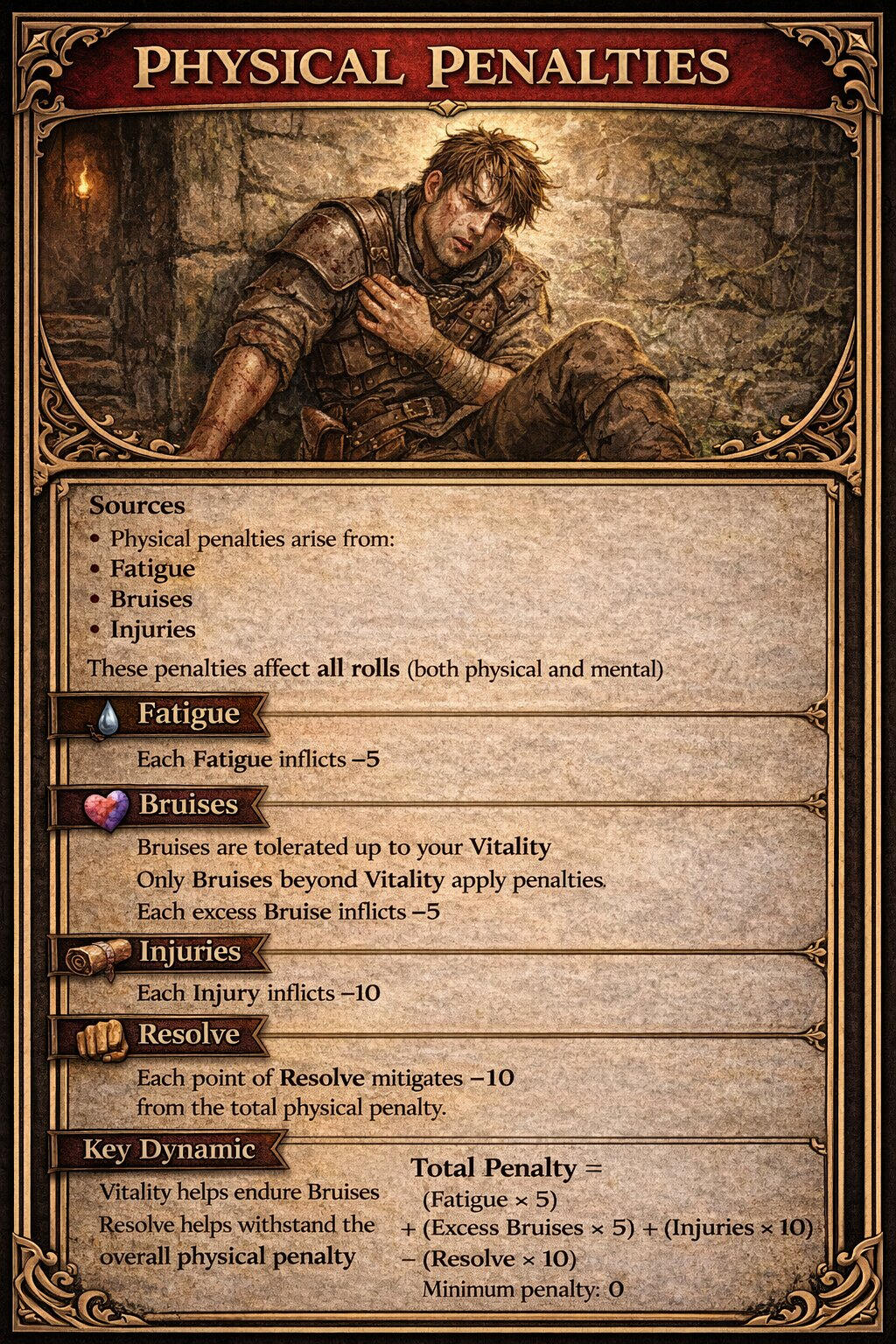
Fatigue thresholds
Blessings or penalties
Wounds or conditionsThe DM may declare a target number, or may keep it undisclosed.
Circumstances matter.
Characters
Each character is built through a structured allocation of points into:
Core Domains (Primary, Secondary, Tertiary, Peripheral)
Knowledge & Proficiencies (KP)
Luck (rerolls outside combat)
Thresholds (Body and Mind)
These traits define what your character excels at, what they manage competently, and what they simply cannot do.
A warrior may attempt magic—but without the appropriate Domain, it will fail.
A mage may swing a blade—but not with the skill of a veteran knight.Characters are not Archmages, Highlords, or world-saving champions.
They are trained individuals within a structured Order.
Or striving to gain access into it.
Avoid min-max mentality. Build what feels coherent.
All characters will have their sheets.It is the player’s responsibility to:
Know their Character Sheets.
Track thresholds and relevant values.
Declare accurate modifiers when requested..
The DM will not memorize every statistic.
In tabletop systems like Dungeons & Dragons, a fixed group advances together.World of Warcraft roleplay is different.
Attendance fluctuates.
Members join and leave.
Real life intervenes.For this reason:
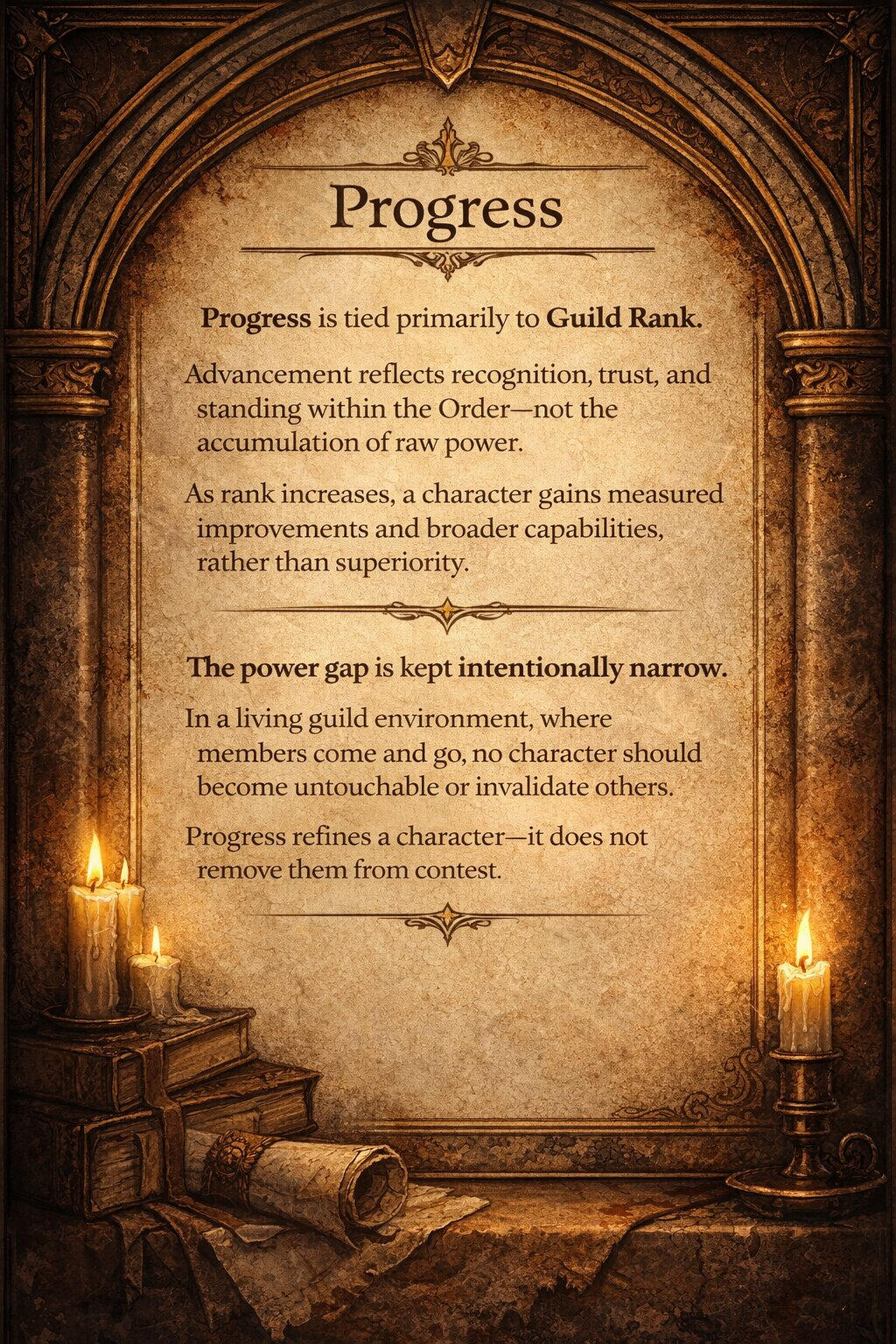
Statistical growth is limited and controlled.
True progression is found in:
Relationships between characters.
Consequences of past events.
Reputation earned or damaged.
Campaign developments shaped by player decisions.
The most meaningful growth is narrative.
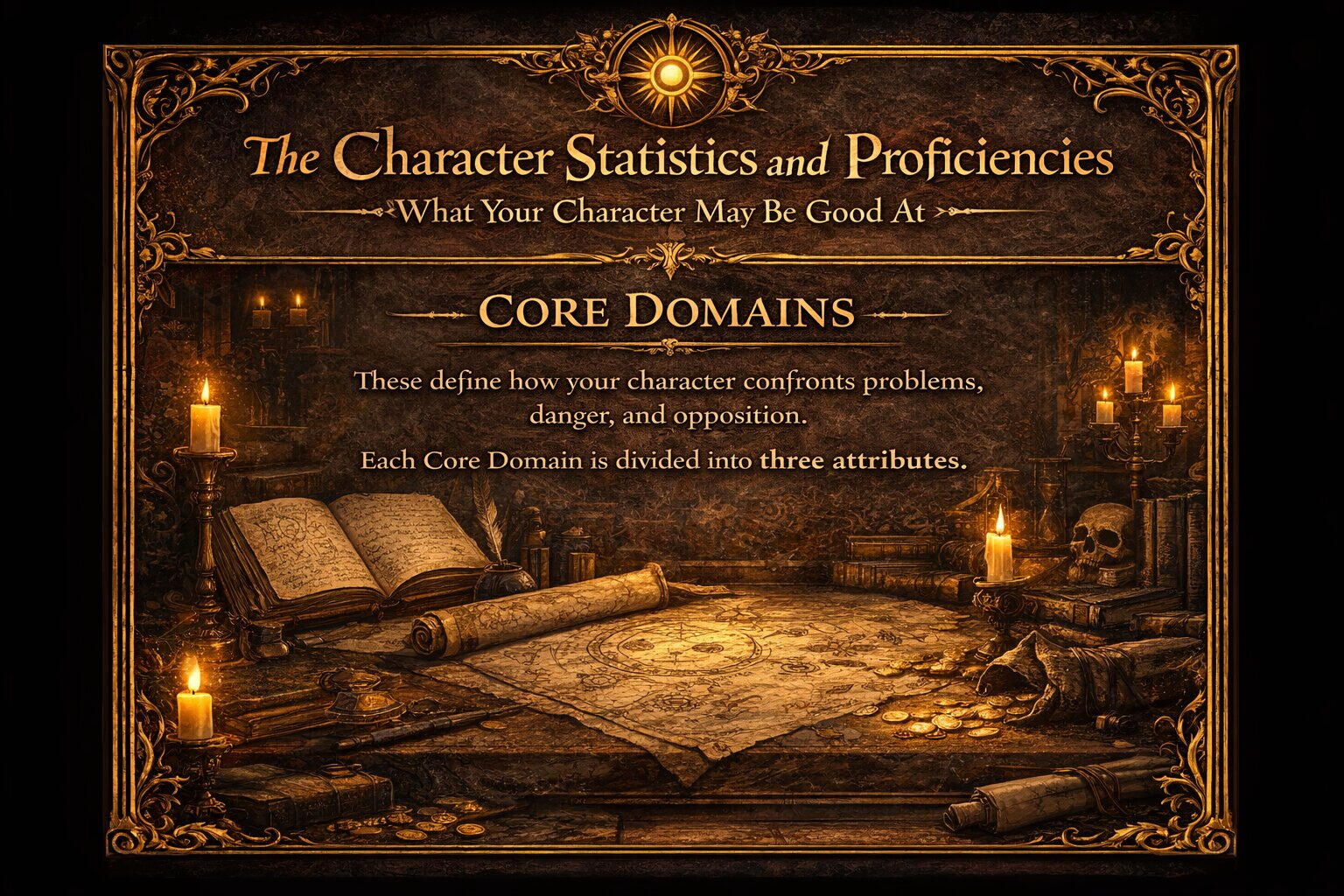

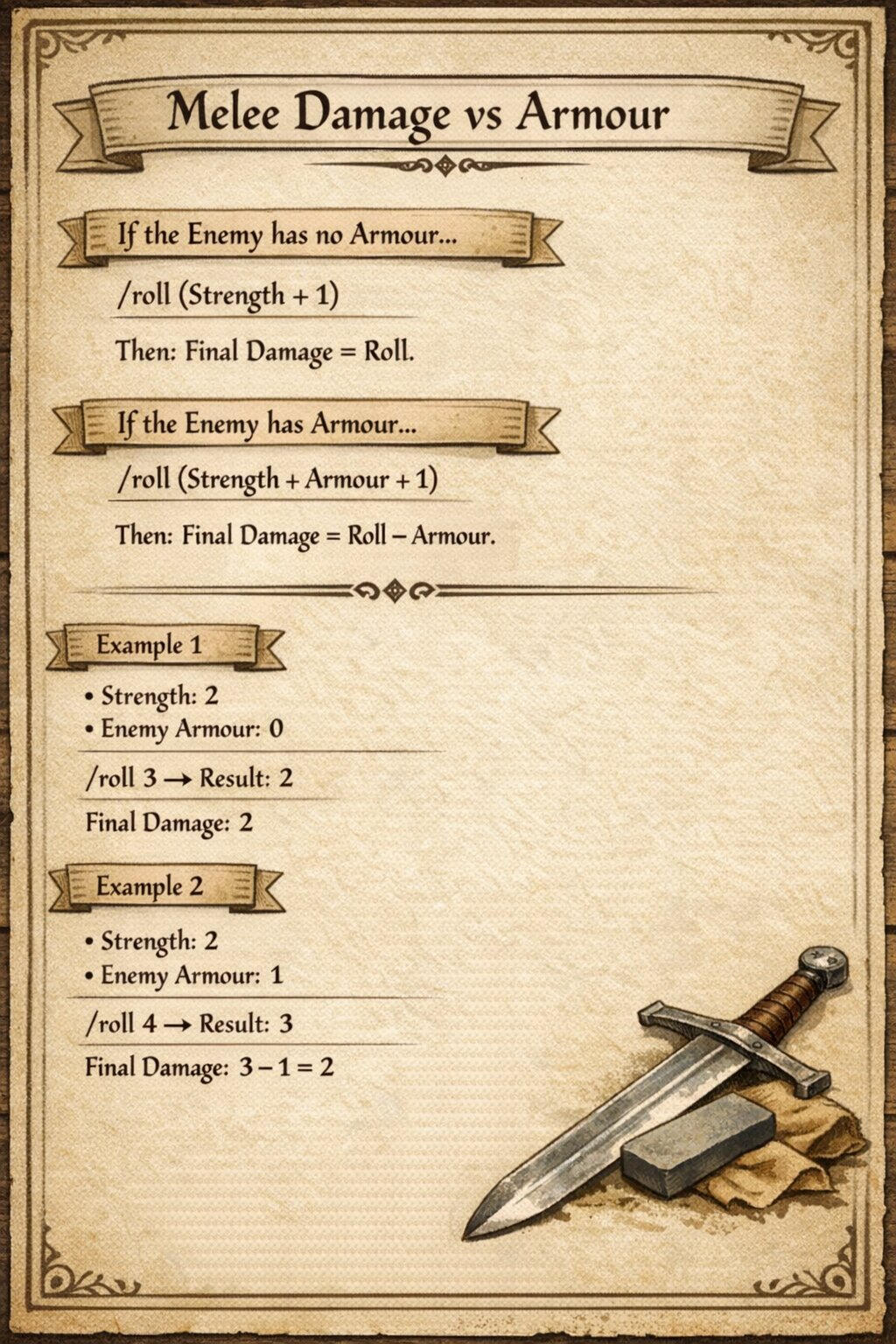
The raw substance of your physical being.• Strength – Affects Melee damage; used for Brute Force tests (arm-wrestling, breaking doors,
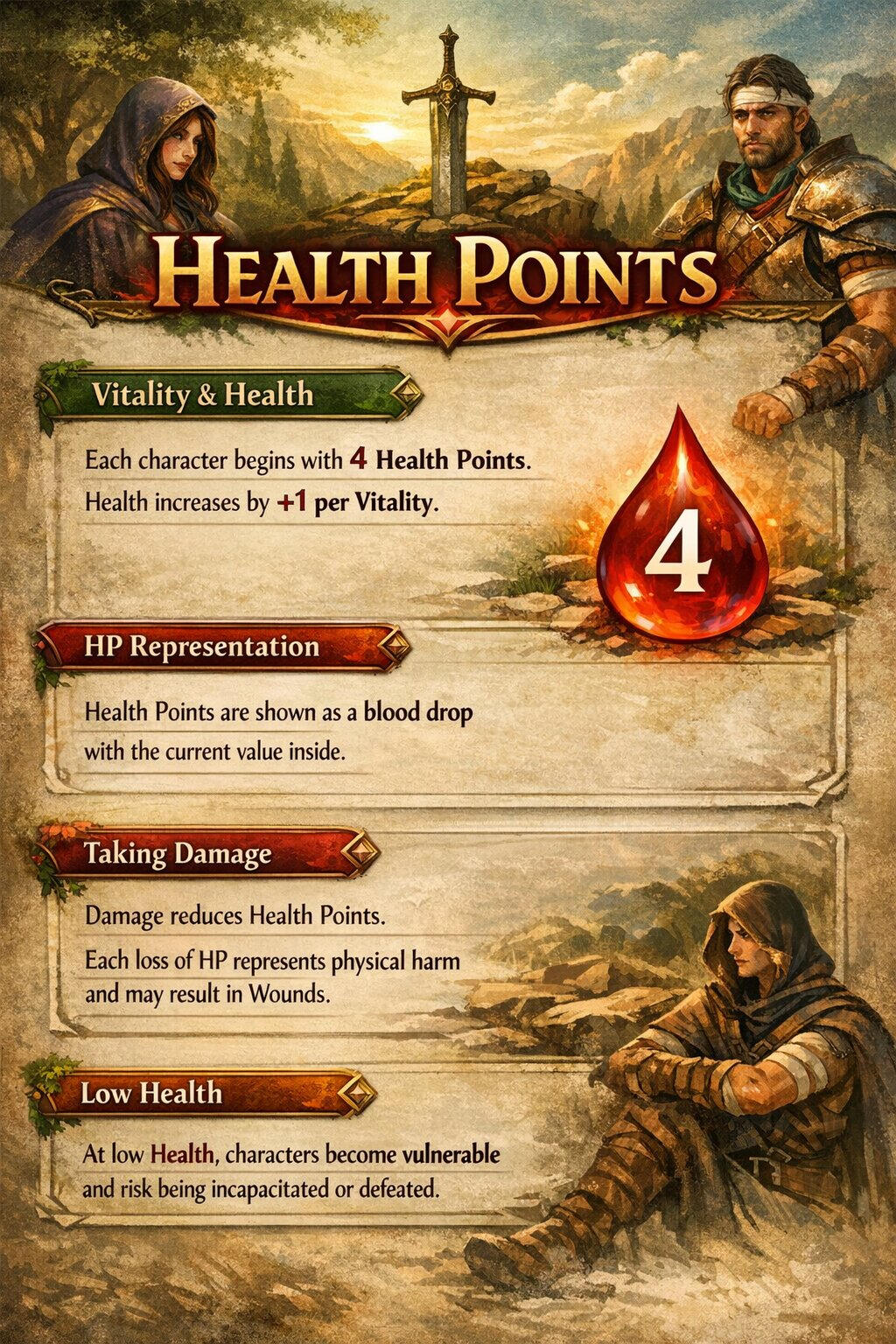
overpowering an opponent).• Vitality – Determines how many injuries you can endure; grants Health Points.• Endurance – Resistance to Fatigue and Poisons; governs sustained effort.

How you move and control your body.• Mobility – Running speed and repositioning; used for pursuit and moving across rough terrain.• Athletics – Climbing, jumping, swimming, grappling, and other physical maneuvers.• Dexterity – Sleight of hand, quick drawing of blades or firearms, fine manual control.

Close combat discipline. Fighting unarmed or without proper training may incur severe
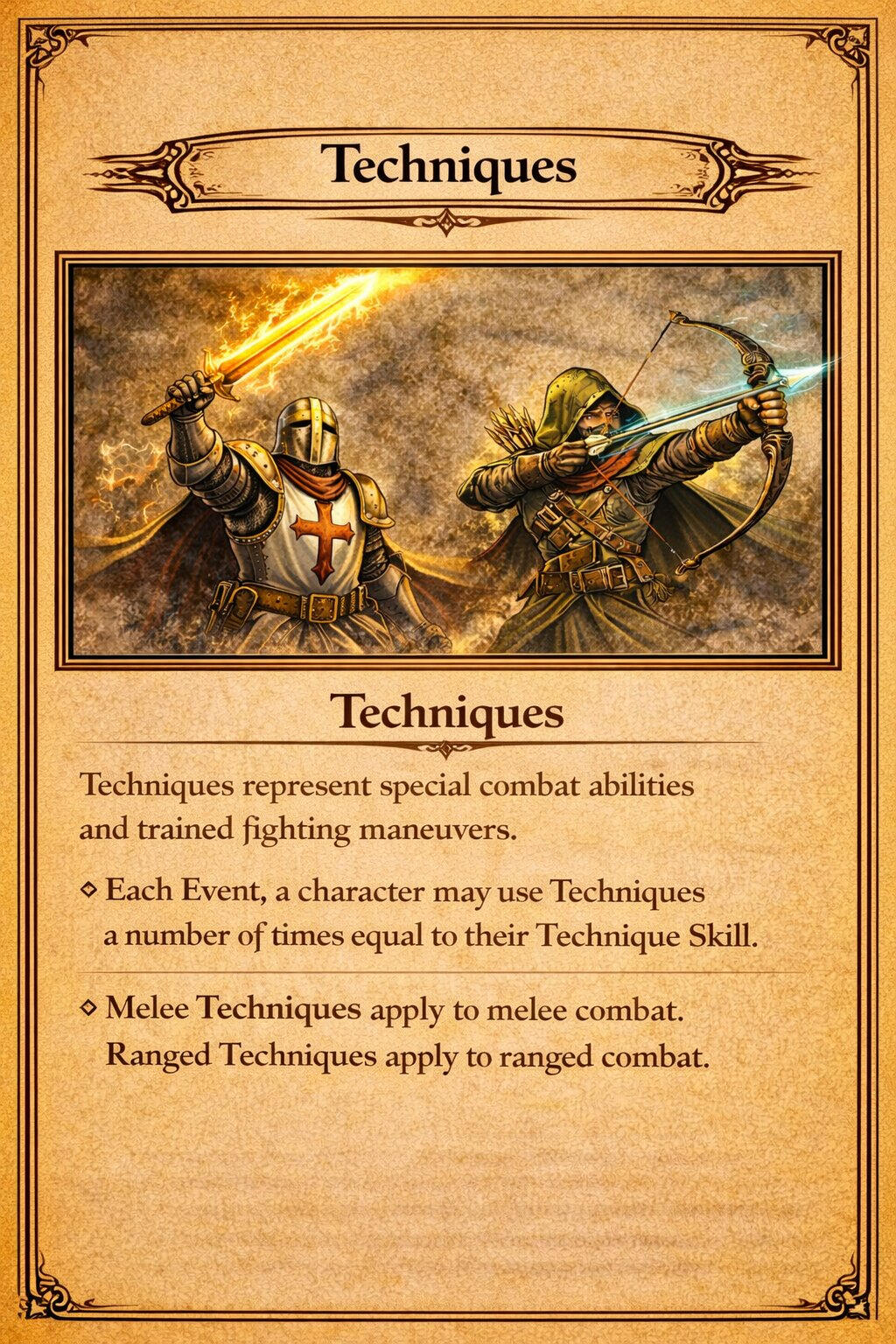
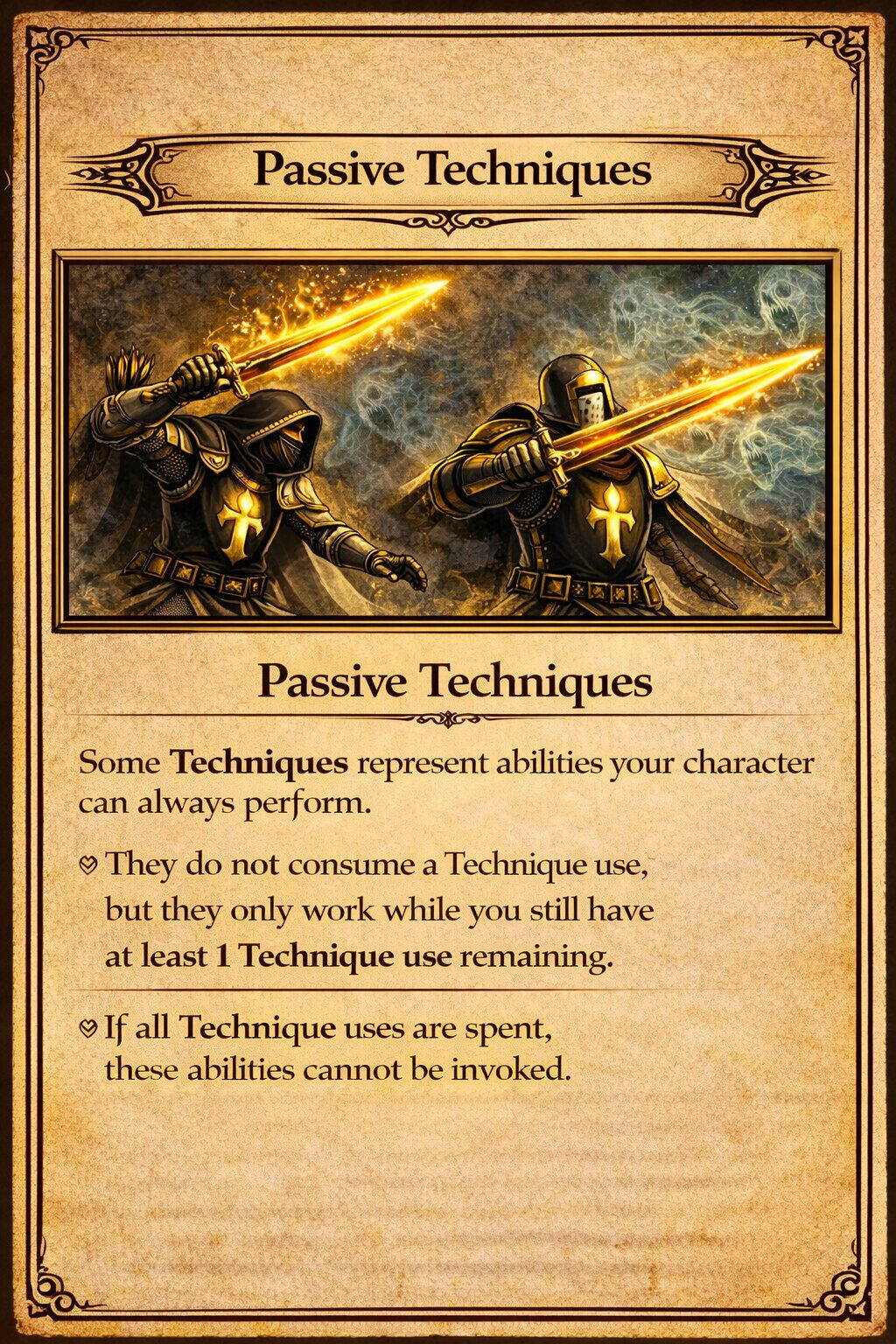
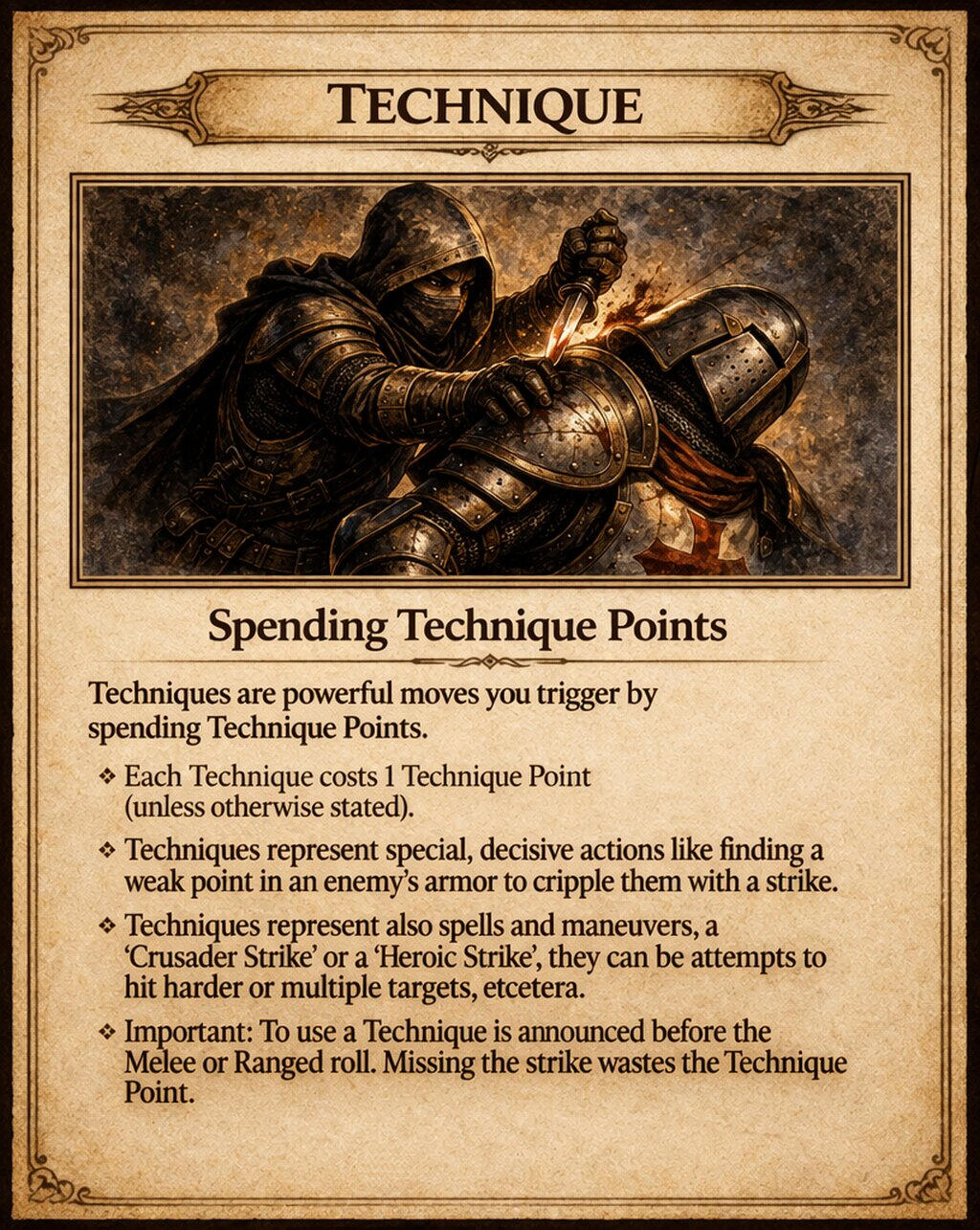
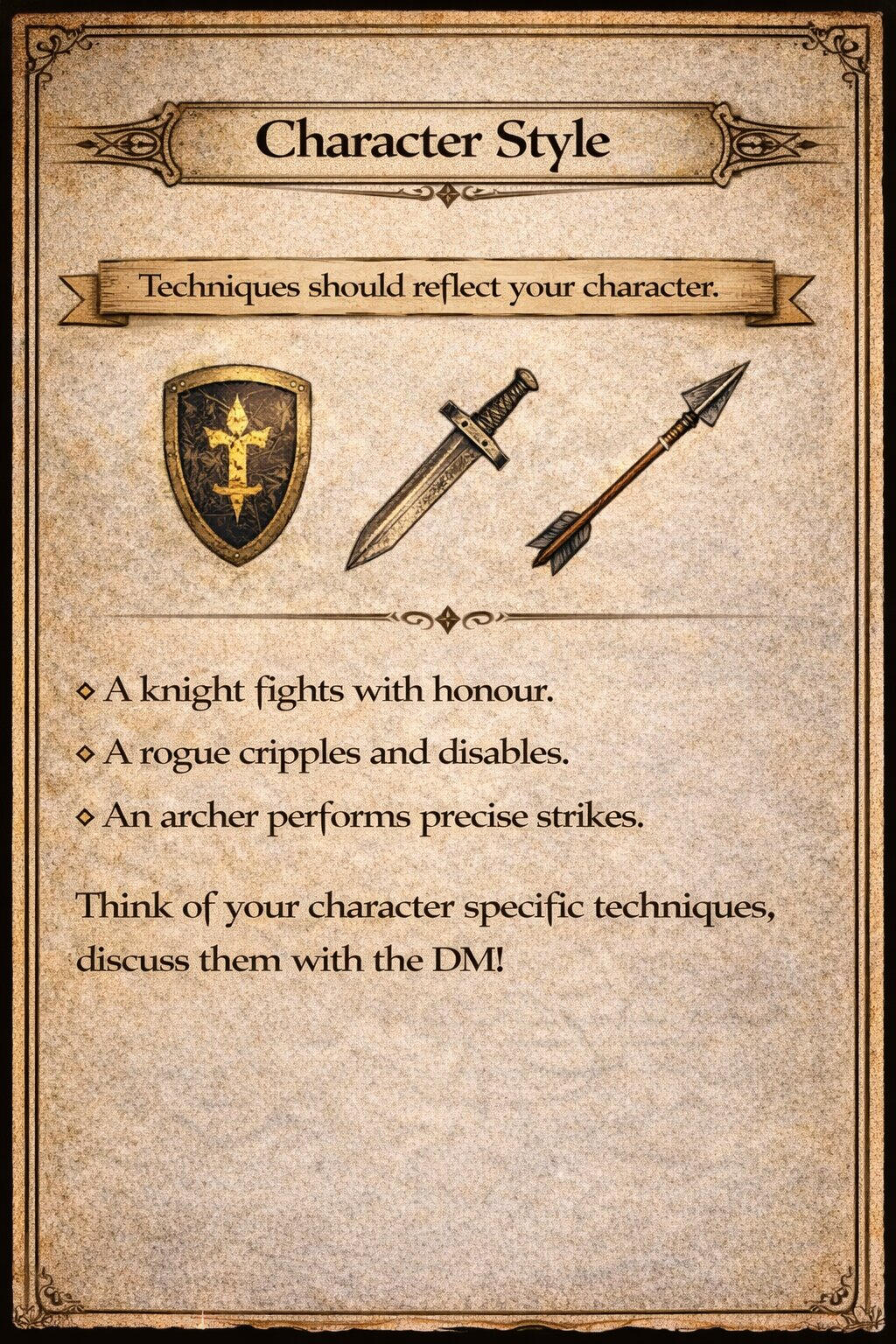
disadvantage.• Combat – Core close-combat ability: attacking, parrying, blocking, anticipating the enemy.• Techniques – Trained maneuvers (disarm, hamstring, bless a blade, heroic strike, etc.).
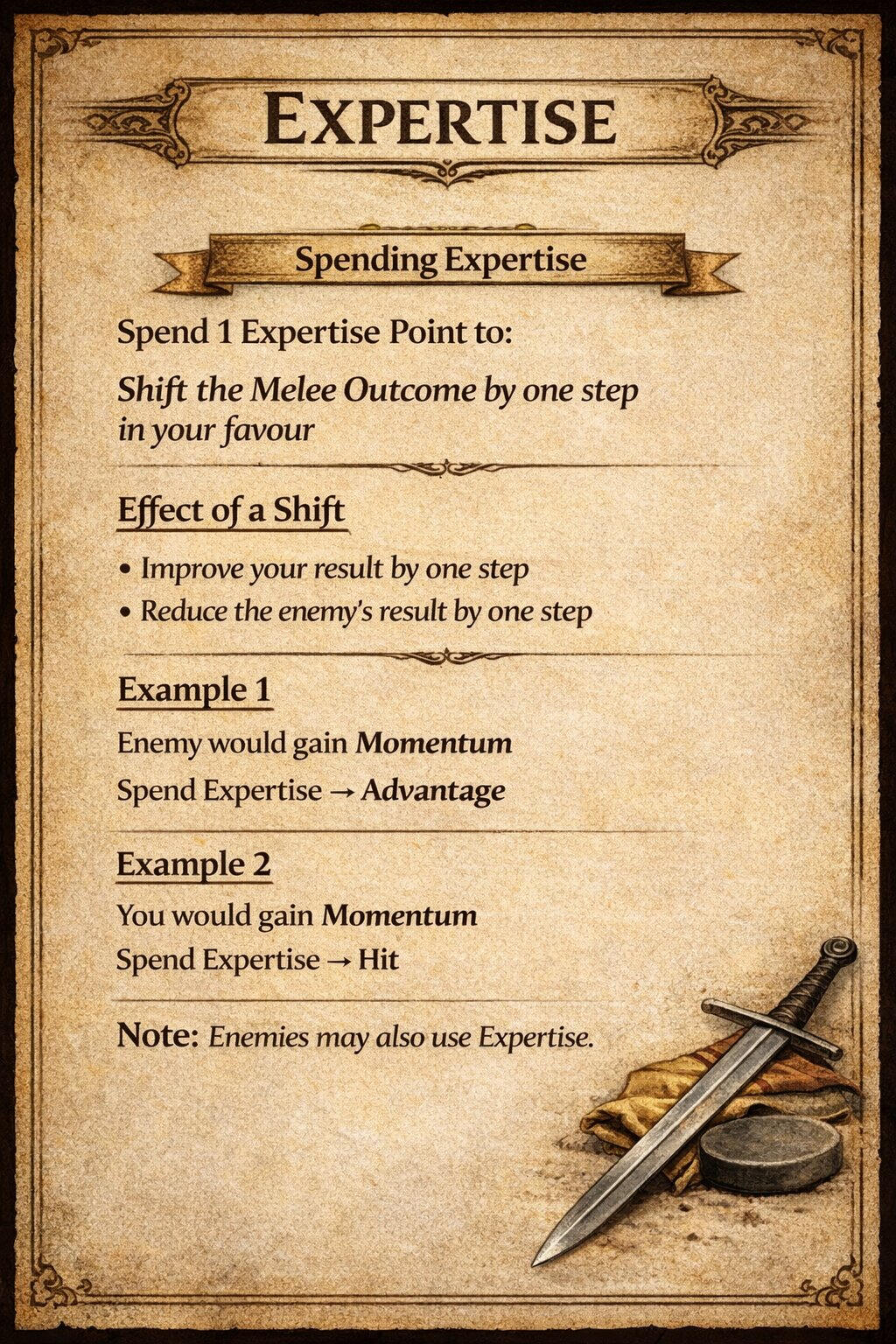
These represent limited-use battlefield actions.• Expertise – The ability to influence or alter the outcome of a Melee Combat roll (rerolls, tactical advantage, composure in combat).

Precision at distance. Baseline requirement: remain stationary and not engaged in melee to shoot.• Aim – Hitting targets with bow, crossbow, firearm, or similar ranged weapon.• Throw – Hitting targets at short distance with daggers, hatchets, javelins, and similar weapons.• Techniques – Special shots and prepared projectile maneuvers (pinning shot, disarming
shot, suppression fire, etc.). These represent limited-use tactical actions.

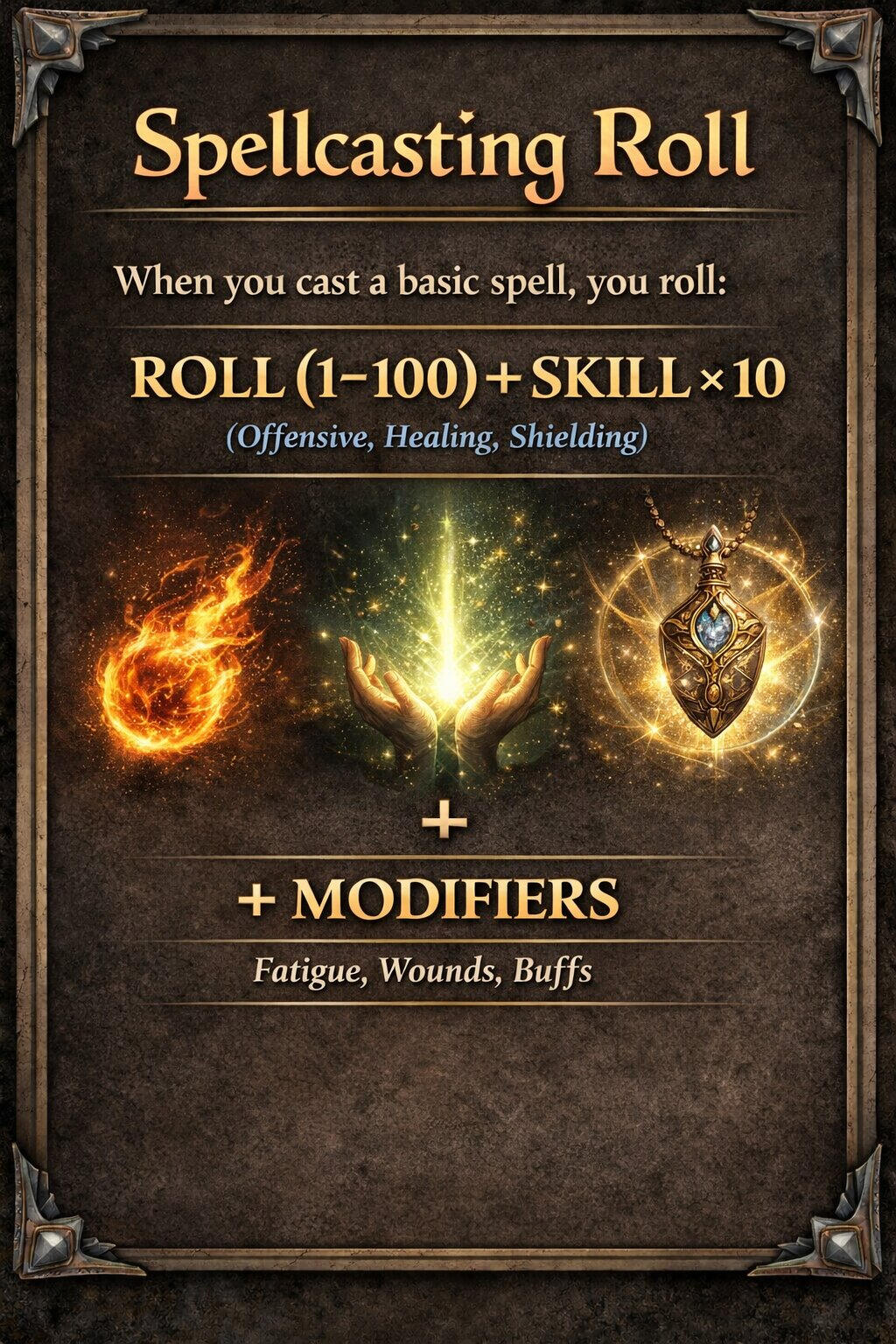
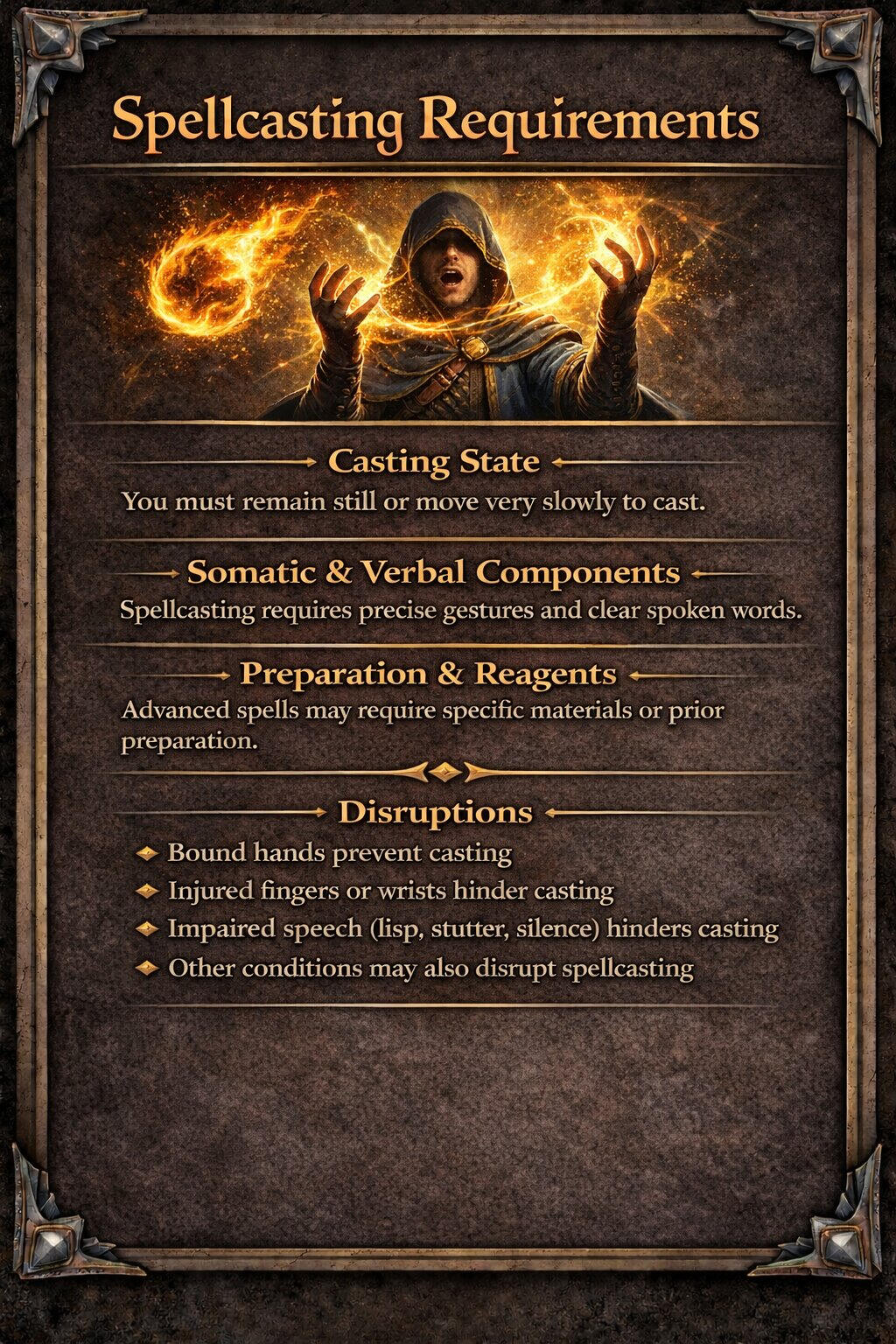
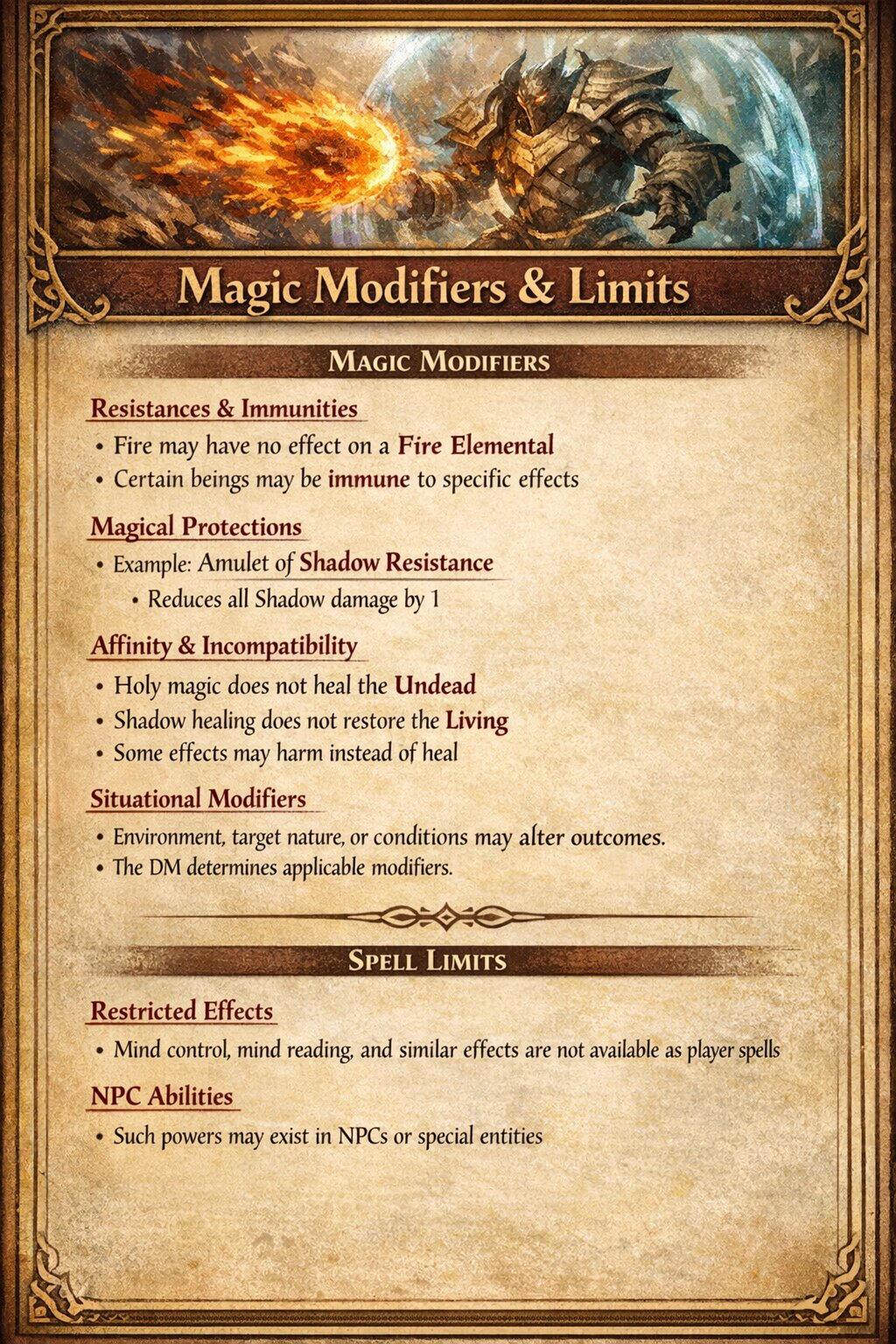
Magic meant to harm, debilitate, or overwhelm. Different magical traditions express destructive power in different ways. - Offensive magic can be Fire, Arcane, Frost, etcetera.• Casting – The act of shaping destructive magic.• Lore – Knowledge of destructive forms and advanced spells.• Surge – The ability to push magic beyond its baseline limits.

Magic meant to restore wounds, cleanse poison, purify food and water, and sustain life.• Casting – The act of healing and restoration.• Lore – Knowledge of advanced restorative rites.• Surge – Extraordinary restorative effort beyond the ordinary.

Magic meant to restore wounds, cleanse poison, purify food and water, and sustain life.• Casting – The act of healing and restoration.• Lore – Knowledge of advanced warding or utility rites.• Surge – Extraordinary utility and protection effort beyond the ordinary.

Strength of mind and inner control.• Willpower – Resisting mental intrusion, manipulation, fear, and supernatural coercion.• Focus – Maintaining concentration under pressure; essential when sustaining complex actions.• Resolve – Enduring hardship and adversity; pushing through wounds or fatigue.

The power to shape people.• Charisma – Diplomacy, negotiation, presence, seduction.• Intimidation – Threat, dominance, psychological pressure.• Leadership – Inspiring, organizing, and commanding others.

The art of operating unseen or indirectly.• Stealth – Hiding and moving without detection; enabling surprise attacks.• Deception – Lies, disguise, misdirection—and detecting such tactics in others.• Intrusion – Locks, traps, infiltration, and bypassing secured areas.

Attunement to surroundings and subtle details.• Observation – Noticing visual details, anomalies, and environmental clues.• Perception – Heightened sensory awareness (sound, smell, instinctive recognition).• Attunement – Sensitivity to supernatural or otherworldly impressions; sensing the unseen through
intuition.

Luck is a measure of fortune outside of battle.It enables rerolling and taking the second result in non-combat situations.Luck represents rare moments where fate intervenes in your character’s favor. It cannot be used to determine the outcome of direct combat actions.
This list is not exhaustive.
Players may propose new proficiencies consistent with the setting.

TrackingSurvivalNavigationRidingAnimal Handling

HeraldryHistoryTheologyDemonologyLanguages (beyond the Common)

AlchemySmithingEngineeringHerbalismRunic Inscription

NobilityUnderworld ContactsMercantile NetworksMilitary Background

Before assigning any numbers or ranks, you must first decide what truly defines your character.Every character is shaped by their focus.You must choose:• One Primary Core Domain• Two Secondary Core Domains• Three Tertiary Core DomainsAll remaining Core Domains are considered Peripheral to your character.A Primary Domain represents your defining strength — what you are known for.Secondary Domains support and reinforce your identity.Tertiary Domains represent training, familiarity, or lesser focus.Peripheral Domains are not absent — they are simply not central to who you are.This choice comes before any point allocation.Do not think in numbers yet. Think in identity.Ask yourself:• What does my character rely on when things go wrong?• What do they fall back on instinctively?• What are they respected for?• What are they clearly not?Only after answering these questions should you proceed.If you struggle, read the following examples. They are here to help.

Let us imagine Brother Thaumel.
The player pauses before the list.
Thamael is a devout servant of the Light.
He heals the wounded. He speaks with calm authority.
He is not a battlefield juggernaut.
Now comes the choice.Primary Domain…
Should it be Healing Magic?
Or should it be Discipline, reflecting inner conviction?
The player considers:
Thamael is first and foremost a healer.
His identity revolves around restoration.
Primary: Healing Magic.
Good.Now Secondary Domains.
Thamael must maintain composure under pressure.
He cannot falter while invoking sacred rites.
So:
Secondary: Discipline.
He is also accustomed to guiding others, speaking in counsel, calming fear.
Secondary: Influence.Now Tertiary Domains.
Thamael is no warrior, but he knows how to defend himself.
Tertiary: Melee.
He has learned protective blessings and minor supportive manifestations.
Tertiary: Protection & Utility Magic.
Lastly, he is observant and attentive to the world around him.
Tertiary: Awareness.What has he left Peripheral?
Body.
Athletics.
Ranged.
Offensive Magic.
Subterfuge.
He is not strong.
Not nimble.
Not a destroyer.
Not a shadow operative.
That absence defines him just as much as his strengths.Only after this identity is shaped does the player move on to distributing points. ~ Seen in the "Base Stats"

A woman arrives seeking service.
She speaks gently.
She prays correctly.
She listens more than she talks.
But she was not sent by the Light.
She was sent to observe.Step One – Primary Domain
She must survive in hostile proximity.
She must lie convincingly.
She must avoid detection.
Her core identity is not violence.
It is concealment.
Primary: Subterfuge
This defines her.
She lives in:
• Stealth
• Deception
• Intrusion
Without this as Primary, she cannot function as an infiltrator.Step Two – Secondary Domains
She must not crumble under scrutiny.
Secondary: Discipline
She will be questioned.
Tested.
Pressured.
Her composure must not break.
She must maintain her story.
Second Secondary?
Influence is tempting.
But a true infiltrator avoids attention.
Instead:
Secondary: Awareness
She must:
• Notice when she is watched.
• Detect subtle suspicion.
• Recognize coded signals.
• Read the room.
Awareness protects Subterfuge.Step Three – Tertiary Domains
Now she needs operational survivability.
She is not a frontline combatant,
but she cannot be helpless.
Tertiary: Melee
Basic competence.
Enough to defend herself if cornered.
Next:
She must maintain cover as a Sister.
If the Order expects prayer or minor miracles:
Tertiary: Healing Magic (Holy)
Not extraordinary.
But sufficient to pass as devout.
Final Tertiary:
She must navigate hierarchy and speak properly when required.
Tertiary: Influence
Not commanding.
But socially competent.What Is Peripheral?
Body
Athletics
Ranged
Offensive Magic
Protection Magic
She is not strong.
Not fast.
Not destructive.
Not a battlefield presence.
If exposed in open war,
she is in danger.
And that is correct.

Two characters built from the same menu:
Brother Thamael:
• Identity through Healing and conviction.
Sister Vaelith:
• Identity through deception and perception.
Neither required exotic rules.
Neither required new domains.
The system already supports both.Next comes allocating points to the Core Domains attributes. We can get to the Step 2.

You have already chosen:
• One Primary Core Domain
• Two Secondary Core Domains
• Three Tertiary Core Domains
All remaining Core Domains are considered Peripheral.Now you will assign your points.
You have 100 Design Points (DP).
DP are used to increase Traits within your Core Domains.
At character creation, a Trait may be raised up to Rank 5.
When you buy ranks, the total DP cost depends on whether the Domain is Primary, Secondary,
Tertiary, or Peripheral.
Luck is also purchased with DP and uses the Peripheral cost line.

Primary Domain
Rank 1 → 1
Rank 2 → 2
Rank 3 → 4
Rank 4 → 7
Rank 5 → 11Secondary Domain
Rank 1 → 1
Rank 2 → 3
Rank 3 → 6
Rank 4 → 10
Rank 5 → 15Tertiary Domain
Rank 1 → 2
Rank 2 → 5
Rank 3 → 9
Rank 4 → 14
Rank 5 → 20Peripheral Domain & Luck
Rank 1 → 3
Rank 2 → 7
Rank 3 → 12
Rank 4 → 18
Rank 5 → 25
You have 15 Knowledge Points (KP).
KP are used to purchase Knowledge & Proficiencies (crafts, training, academic fields, background
specialties).
At character creation, a Knowledge/Proficiency may be raised up to Rank 3.KP Cost Reference (Total KP Cost to Reach a Rank)
Rank 1 → 1
Rank 2 → 3
Rank 3 → 6

Before finalizing your sheet, ask yourself:
• Are my strengths obvious?
• Are my weaknesses meaningful?
• Does this reflect my character concept?A clear weakness is as defining as a clear strength.If you struggle, read the following examples. They are here to help.

Step A — Summary of Core Domains
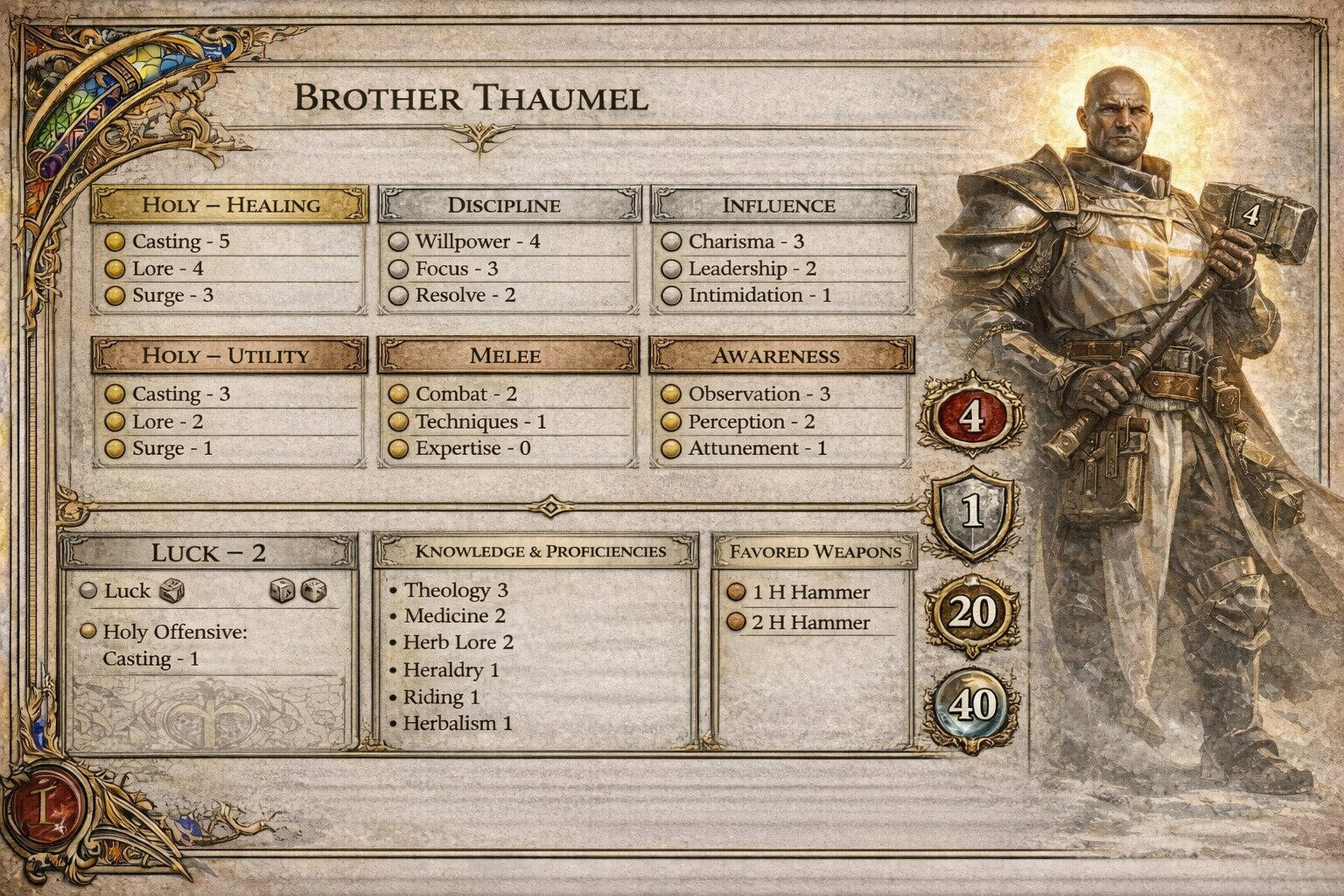
Thaumiel is a calm, devout healer. Not a duelist, not a sprinter.
• Primary: Healing Magic
• Secondary: Discipline, Influence
• Tertiary: Protection & Utility Magic, Melee, Awareness
Everything else Peripheral.Step B — Spend 100 DP (thinking out loud)1) Start with the identity anchor (Primary: Healing Magic).
“I must be excellent at healing.”
• Healing Casting 5 (Primary rank 5 = 11)
• Healing Lore 4 (Primary rank 4 = 7)
• Healing Surge 3 (Primary rank 3 = 4)
Subtotal: 22 DP
DP remaining: 782) Build the “can’t-break-under-pressure” spine (Secondary: Discipline).
“A healer who panics is useless.”
• Willpower 4 (Secondary rank 4 = 10)
• Focus 3 (Secondary rank 3 = 6)
• Resolve 2 (Secondary rank 2 = 3)
Subtotal: 19 DP
DP remaining: 593) Give him believable authority (Secondary: Influence).
“He’s not a tyrant. He’s steady.”
• Charisma 3 (Secondary 3 = 6)
• Leadership 2 (Secondary 2 = 3)
• Intimidation 1 (Secondary 1 = 1)
Subtotal: 10 DP
DP remaining: 494) Add modest support capability (Tertiary: Protection & Utility Magic).
“Basic wards and blessings—enough to be useful.”
• Casting 3 (Tertiary 3 = 9)
• Lore 2 (Tertiary 2 = 5)
• Surge 1 (Tertiary 1 = 2)
Subtotal: 16 DP
DP remaining: 335) Awareness (Tertiary) so he isn’t oblivious.
“He notices danger and the ‘wrongness’ in rooms.”
• Observation 3 (Tertiary 3 = 9)
• Perception 2 (Tertiary 2 = 5)
• Attunement 1 (Tertiary 1 = 2)
Subtotal: 16 DP
DP remaining: 176) Minimal self-defense (Tertiary: Melee).
“He can survive being cornered, but he’s not a warrior.”
• Melee Combat 2 (Tertiary 2 = 5)
• Techniques 1 (Tertiary 1 = 2)
• Expertise 0 (0 = 0)
Subtotal: 7 DP
DP remaining: 107) Buy Luck from DP (Peripheral scale).
“I want an emergency reroll for a trap or catastrophe.”
• Luck 2 (Luck uses Peripheral: rank 2 total = 7)
Subtotal: 7 DP
DP remaining: 38) Spend the last few points to round him out.
• Melee Expertise 1 (Tertiary 1 = 2)
• Awareness Attunement 2 (Tertiary 2 = 5) is too costly now.
Instead: raise Resolve 3 (Secondary 3 = 6) also too costly.
So: take something modestly useful:
• Protection Lore 3 (Tertiary 3 = 9) too costly.
Best fit: add a small bump to Melee Combat? (2→3 would be Tertiary 3 = 9 total, but you’ve
already paid 5; the difference is 4 — you’re not tracking differences here, so keep it simple and
avoid upgrades mid-example.)
So we leave 3 DP unspent (allowed), or convert it into Luck 3? (Luck 3 total 12, not possible). But we can afford a single point in a Peripheral. Let us give Brother Thaumel a smiting capability at range too.✅ Final DP spend: 100 / 100Step C — Spend 15 KP (Knowledge/Proficiencies)
Thaumiel is a scholar-healer.
• Theology 3 (KP rank 3 = 6)
• Medicine 2 (KP rank 2 = 3)
• Herb Lore 2 (KP rank 2 = 3)
• Heraldry 1 (KP rank 1 = 1)
• Riding 1 (KP rank 1 = 1)
• Herbalism 1 (KP rank 1 = 1)✅Subtotal KP: 15 / 15

Step A — Pick Core Domains
She infiltrates. She observes. She lies beautifully.
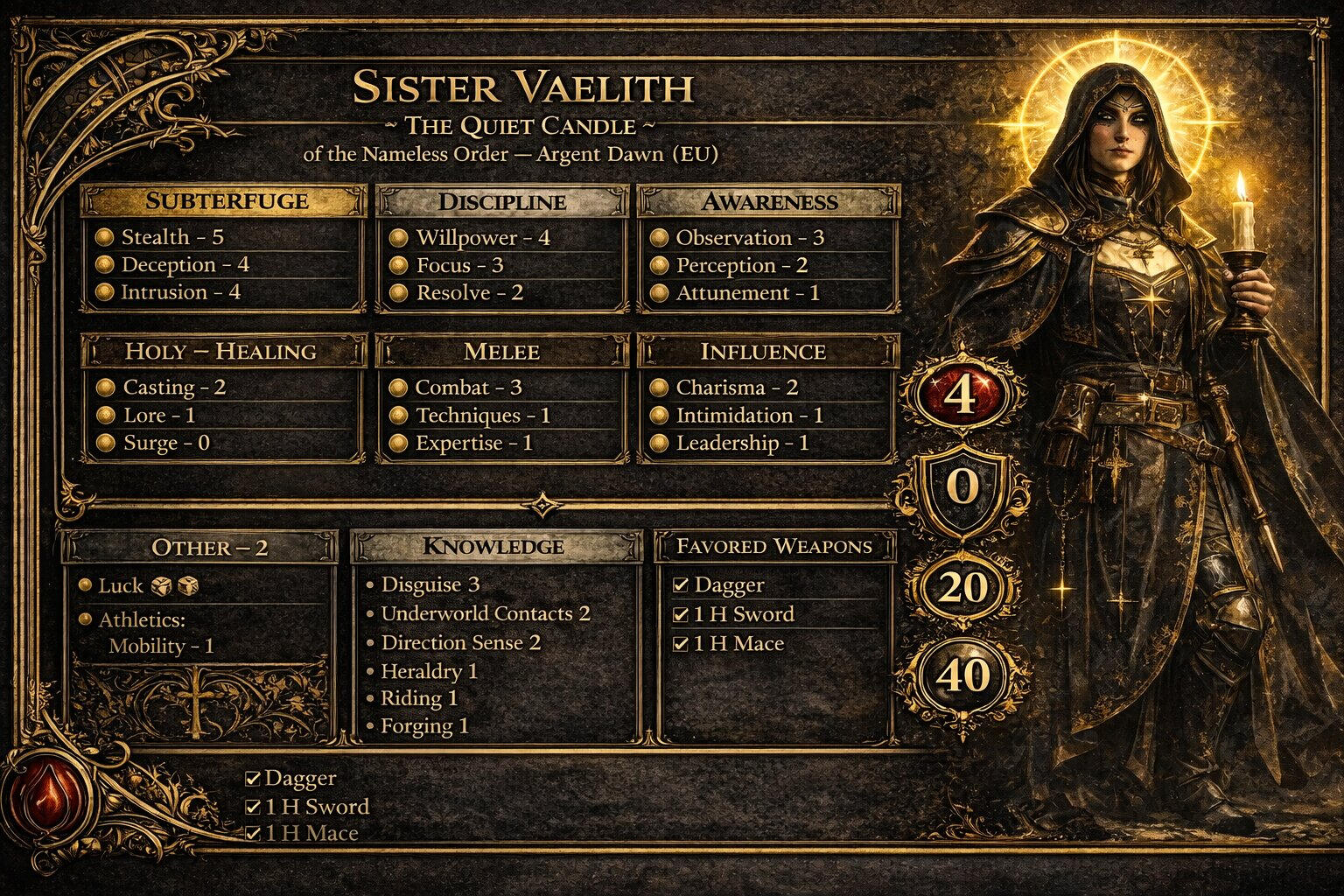
• Primary: Subterfuge
• Secondary: Discipline, Awareness
• Tertiary: Healing Magic (Holy), Melee, Influence
Everything else Peripheral.Step B — Spend 100 DP1) Anchor the concept (Primary: Subterfuge).
“She must remain unseen, unbroken, and capable of entry.”
• Stealth 5 (Primary 5 = 11)
• Deception 4 (Primary 4 = 7)
• Intrusion 4 (Primary 4 = 7)
Subtotal: 25 DP
DP remaining: 752) Build the mask (Secondary: Discipline).
“Scrutiny is constant. She cannot crack.”
• Willpower 4 (Secondary 4 = 10)
• Focus 3 (Secondary 3 = 6)
• Resolve 2 (Secondary 2 = 3)
Subtotal: 19 DP
DP remaining: 563) Give her the room-reading edge (Secondary: Awareness).
“She detects suspicion before it speaks.”
• Observation 4 (Secondary 4 = 10)
• Perception 3 (Secondary 3 = 6)
• Attunement 1 (Secondary 1 = 1)
Subtotal: 17 DP
DP remaining: 394) Keep the cover believable (Tertiary: Healing Magic, Holy).
“Not a miracle-worker. Just enough to pass as a Sister.”
• Casting 2 (Tertiary 2 = 5)
• Lore 1 (Tertiary 1 = 2)
• Surge 0
Subtotal: 7 DP
DP remaining: 325) She’s not helpless in a corner (Tertiary: Melee).
• Melee Combat 3 (Tertiary 3 = 9)
• Techniques 1 (Tertiary 1 = 2)
• Expertise 1 (Tertiary 1 = 2)
Subtotal: 13 DP
DP remaining: 196) Social competence (Tertiary: Influence).
“She avoids spotlight, but can speak when needed.”
• Charisma 2 (Tertiary 2 = 5)
• Intimidation 1 (Tertiary 1 = 2)
• Leadership 1 (Tertiary 1 = 2)
Subtotal: 9 DP
DP remaining: 107) Luck (Peripheral scale).
“Two rerolls: one for the trap, one for the falling rock... or maybe the lie roll!”
• Luck 2 = 7 DP
DP remaining: 3
We can afford a single point in a Peripheral with 3 DP. Let us get her a point in Mobility, one of the attributes of the Domain of Athletics.✅ Final DP spend: 100 / 100Step C — Spend 15 KP
Her training is practical, covert, and bureaucratic.
• Disguise 3 (6 KP)
• Underworld Contacts 2 (3 KP)
• Locks & Traps Theory 2 (3 KP)
• Heraldry 1 (1 KP)
• Riding 1 (1 KP)
• Forging 1 (1 KP)✅ Subtotal: 15 / 15
During an event, a Player announces their character’s intended action in RAID CHAT.Only the final goal of the action needs to be stated.
The Dungeon Master (DM) only needs a short and clear declaration.Examples:"Opens the door.""My character charges the Orc Shaman.""I heal Thaumel.""Casting Fireball at the Skull raid marker.""Hide behind a rock.""Charm the merchant, seeking a better price."Short messages are easy for the Dungeon Master to notice and respond to.
If you wish to be even clearer, you may prefix your message:
Action: Opens the door.
Clarification: Does the door have a handle or a lock?After announcing the action, you are free to write longer roleplay in /e (emote) or /s (say).Example emote:Carefully reaching for the iron handle, the Brother turns it slowly, testing whether the door will yield before committing to pushing it open.The DM does not need to read the entire emote to understand the action — the Raid Chat already communicated the intent.The wording "Carefully" may be entirely redundant. The character is opening the door, if there is a trap that may emit a sound, carefully or not - the DM will ask for a test for reaction speed for example!This approach keeps the event clear, fast, and organized, and reduces the chance that a character’s action is overlooked.Important:
Do not roll dice unless the Dungeon Master asks for it.
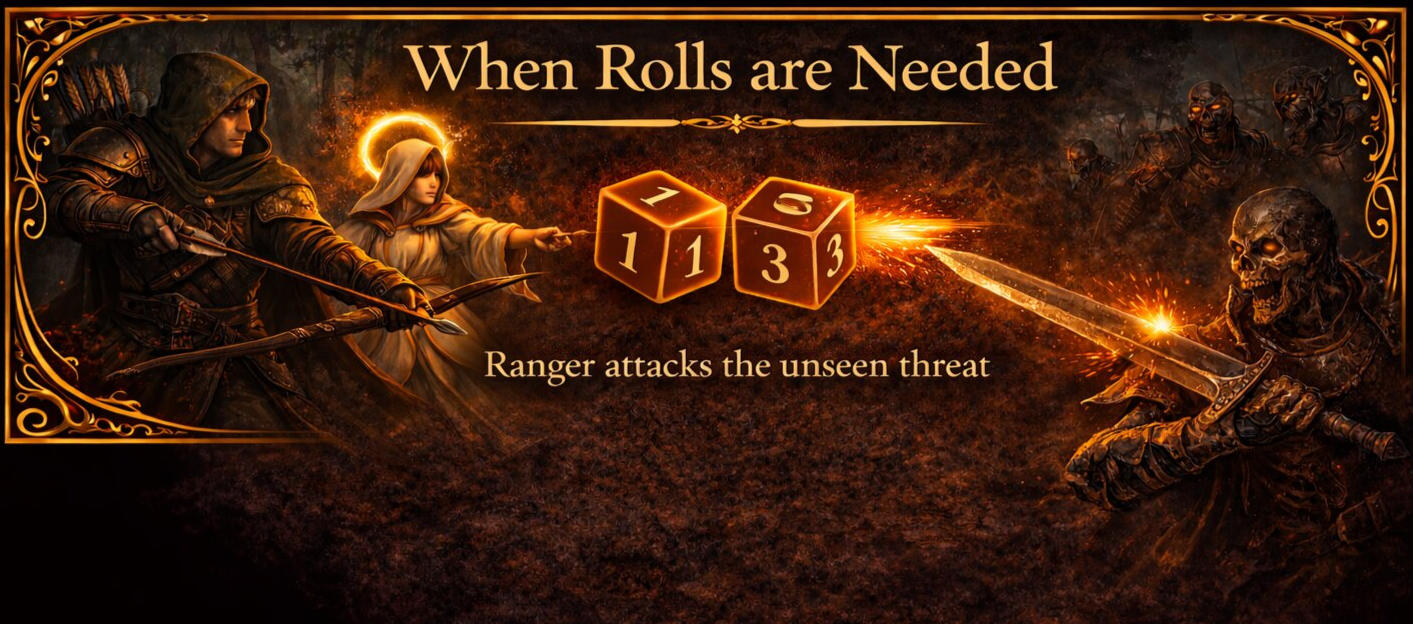
When Rolls Are CalledNot every action requires a roll.If a character has time, space, and no meaningful opposition, the Dungeon Master may simply allow the action to succeed.A modest climber can scale a tree when nothing threatens them.
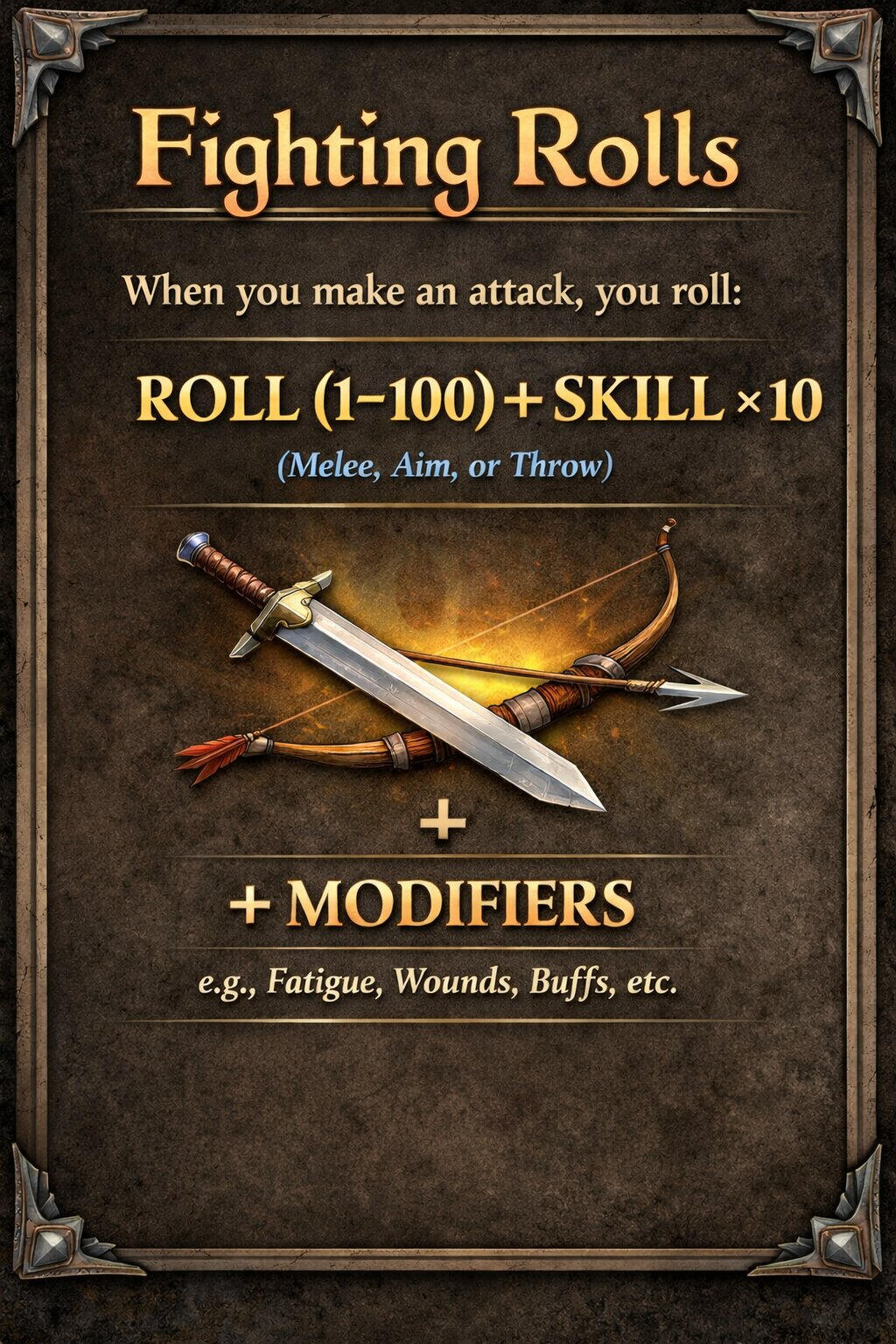
The same climb, if escaping from rabid wolves, becomes uncertain.Rolls represent pressure, danger, opposition, or urgency.When a roll is called, it usually takes one of three forms:
• Test against a Known Threshold
• Test against a Hidden Threshold
• Comparative TestThese determine how the situation unfolds when success is no longer certain.
“O Light, consecrate my fury.
Let my strike fall true,
my judgement burn pure,
and my wrath serve only righteousness.”
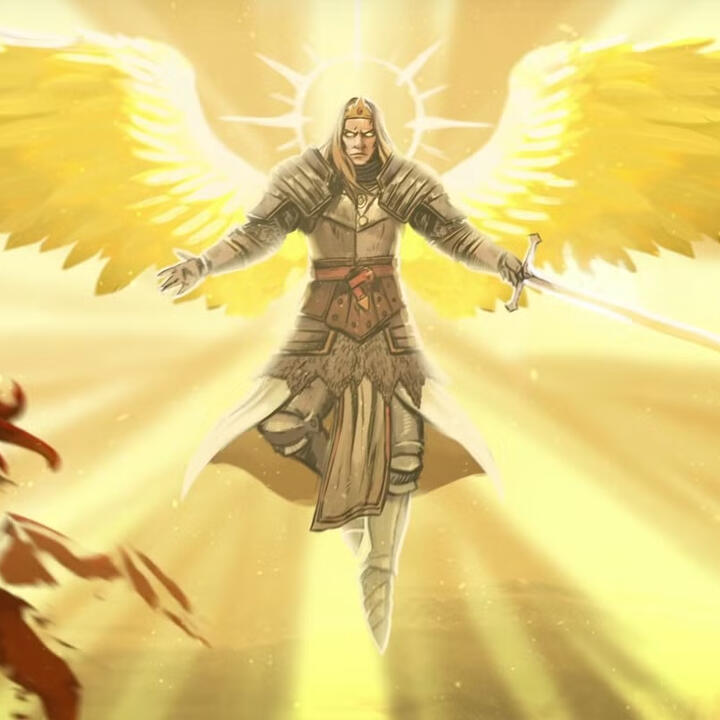
Wrath
Wrath is holy fire disciplined by purpose.It is not rage, nor cruelty, but the Light’s own fury against corruption and wickedness.When unleashed, it must burn cleanly — never upon the innocent, always upon the unrepentant darkness.
“O Light, claim what You require.
My strength, my peace, my breath—
all I am is Yours to spend
for the sake of the righteous.”
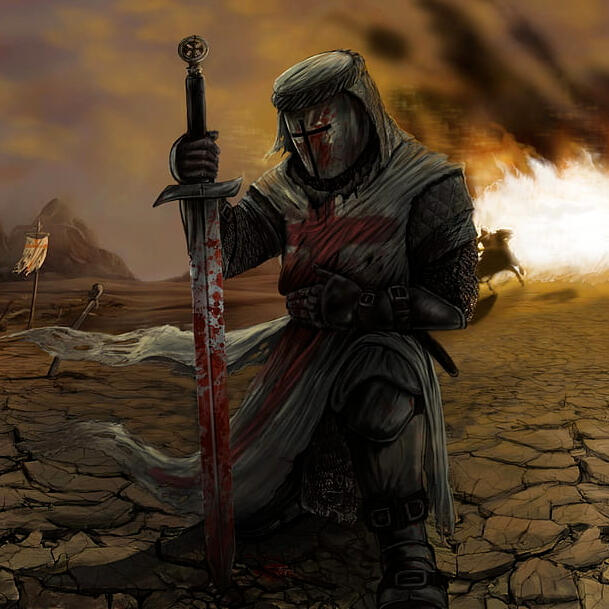
Sacrifice
Sacrifice is the offering of self — freely, wholly, without complaint.Comfort, safety, and even life are coins we spend for the salvation of the faithful and the victory of the Light.To sacrifice is to grasp the truth: that nothing worth defending is ever won without cost.